
Farm Madness: Traffic Jam
RunyouCasual
4.52.00 Reviews
- Version
- 1.1.3
- Installs
- 50.00K
- Age Rating
- Everyone
Screenshots
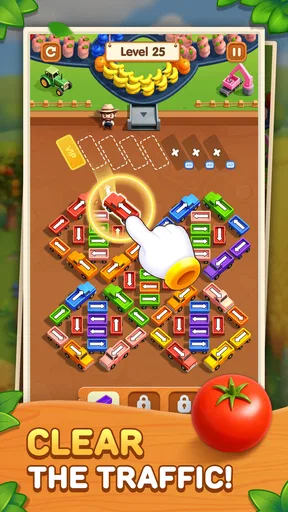
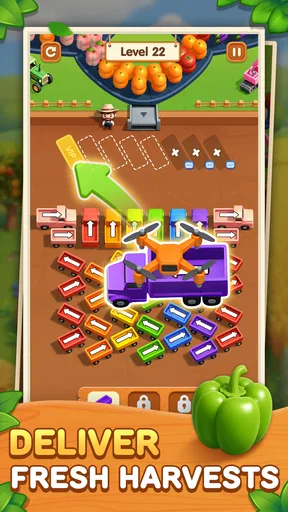
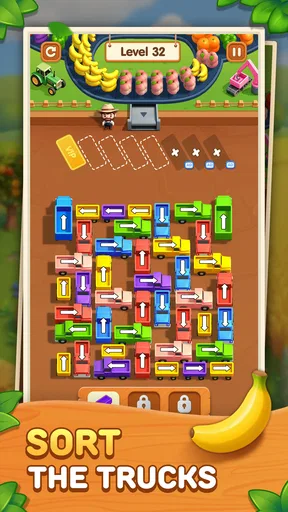
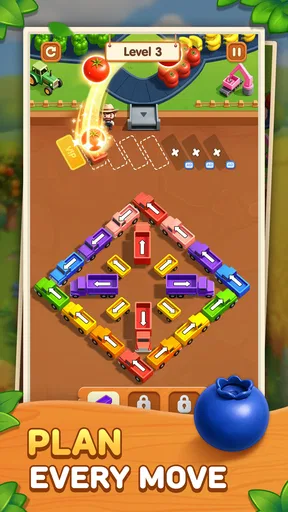
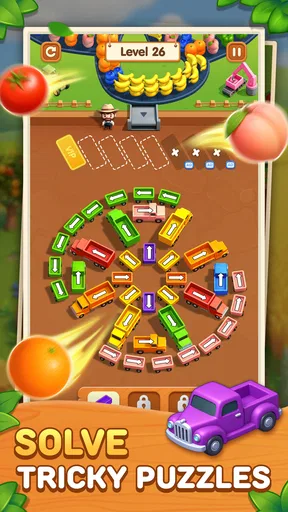
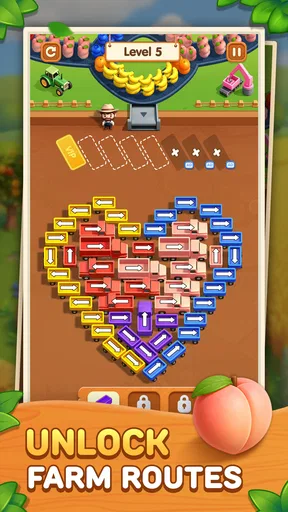
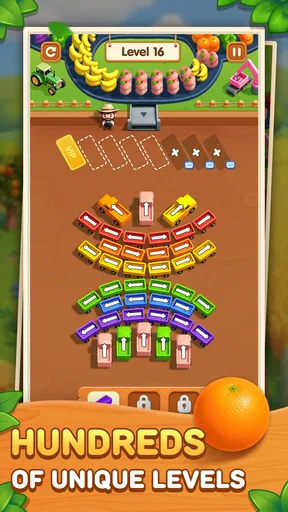
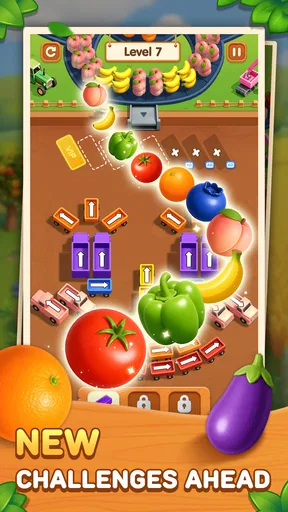
Our Review of Farm Madness: Traffic Jam
 Analysis by Appyee
I spent time with Farm Madness: Traffic Jam as a light, pick-up-and-play puzzle game, and its appeal became clear quickly: it combines several familiar ideas around a farm setting without demanding a long session. The central mood is relaxed, but the puzzles still ask you to notice patterns, plan movement, and avoid making a small traffic mistake that creates a much bigger problem.
That combination makes it a comfortable choice for short breaks. I could imagine opening it while waiting for an appointment, taking a few turns after dinner, or using it as a gentler alternative to a fast arcade game. It is free, aimed at Everyone, and belongs firmly in the casual game space. The important question is not whether it offers a huge, deep campaign, but whether its mixture of color matching, sliding vehicles, parking challenges, and escape-style puzzles gives you enough variety to stay interested.
How the current version feels to play
The current release is version 1.1.3, and the overall experience feels designed around quick mental resets rather than marathon play. The farm theme gives the puzzles a friendly identity, while the individual activities appear to serve different kinds of attention. Color matching is more about recognition and order, vehicle sliding makes you think about space, parking asks for careful sequencing, and escape situations reward patience when the board looks crowded.
I like that this structure can suit different moods. If I want something immediately readable, a color-based challenge is easier to approach than a dense strategy game. When I have more concentration available, a traffic or parking puzzle gives me a reason to stop and think before touching the screen. That change of pace is one of the strongest reasons to try it instead of downloading another single-format matching game.
The word “relaxing” should still be interpreted sensibly. A puzzle can be visually calm while remaining mentally demanding. In the traffic-focused sections, the pressure comes from arranging movement correctly, not from a countdown or frantic controls. That distinction matters for players who dislike reflex-heavy games but still want a small challenge. I found the experience more suitable for deliberate play than for tapping without thinking.
The controls are best approached with a simple habit: inspect the whole arrangement before making the first move. In a parking or sliding situation, the obvious vehicle is not always the one that should move first. A useful routine is to identify the intended exit, then trace which pieces block it, and only afterward start shifting anything. This prevents the common casual-game mistake of using the available space too early.
That planning habit is also where the game offers more value than its short description suggests. The farm presentation may make it look purely decorative, but the traffic puzzles reward spatial reasoning. I found myself mentally testing a couple of moves before committing, especially when one misplaced vehicle could limit the remaining options. Players who enjoy untangling compact boards may appreciate this more than people expecting a simple, automatic match game.
A varied casual format rather than one repeated puzzle
Many casual games build their entire identity around one loop: match pieces, clear obstacles, or move a single object toward a goal. This game is more appealing when you want those familiar ideas to alternate. The color-match element can provide a softer entry point, while the truck-slide and car-parking situations introduce a more physical sense of order. The escape puzzles add another reason to examine the board instead of relying on the same gesture every time.
The trade-off is that players who want one highly polished puzzle system may find the variety less focused. A specialist parking game can devote every level to increasingly precise vehicle movement, and a dedicated match game may offer a more elaborate progression around combinations. Farm Madness: Traffic Jam instead works as a sampler of related casual challenges. I would choose it for variety and accessibility, not for the deepest possible version of any single mode.
It is also worth setting expectations about the farm theme. The setting makes the package more approachable, but I would not install it expecting a full farming simulation with crops, production chains, or a large management layer. Its farm identity frames the puzzles; it does not turn the game into a separate economic or building game. That makes it easier to understand, but it may disappoint anyone looking for long-term farm development.
What the release details tell me about its current stage
The game was released on June 11, 2026, and the present version is 1.1.3. That combination suggests a product that has already moved beyond its first public build, while still being early enough that future refinement could matter. I would treat the current experience as the thing to judge today, rather than assuming later updates will add systems that are not currently part of the game.
For existing players, a move to version 1.1.3 is most meaningful as a sign of ongoing iteration, but I would not translate the version number into promises about specific changes. The practical advice is simple: if you already enjoy the puzzle mix, keep the game updated and judge each release by how smoothly it plays on your device. New players can start without needing to understand an older version, because the current build is the relevant starting point.
The developer is Runyou, and the game has reached over fifty thousand installs with an average rating of 4.5 from roughly eight hundred and fifty ratings. Those figures indicate that it has found a real audience, although they do not replace personal testing. A strong average can tell me that the basic concept connects with many players; it cannot tell me whether the particular blend of parking, sliding, and matching fits my own preferences.
Because the game is free, the entry decision is relatively easy. I can try it without committing money, which suits a casual title whose appeal depends heavily on whether its puzzle rhythm feels satisfying to me. Free access does not automatically mean unlimited patience, however. If the game’s pacing, presentation, or challenge balance does not suit you after a reasonable trial, there is little reason to force yourself through it simply because the download costs nothing.
Who will get the most from it
I would recommend it first to players who like compact puzzles but do not want a serious strategy game. It can work for someone who enjoys arranging objects, spotting safe sequences, and solving a board in several small steps. It is also a reasonable choice for families looking for an Everyone-rated game with approachable themes, provided younger players are comfortable with the logic required by the more congested traffic puzzles.
It suits short sessions especially well. A realistic use case would be a commuter opening it for a few minutes between stops, completing a puzzle, and closing the app without needing to remember a complicated story or a large inventory. Another would be a quiet evening when I want something more engaging than passive scrolling but less intense than competitive play. The ability to switch between different puzzle flavors helps those brief sessions avoid feeling identical.
I would be more cautious about recommending it to players who need a strong narrative, online competition, character progression, or a substantial simulation layer. It is not the right replacement for a story-driven adventure or a detailed farm-management game. Likewise, if you mainly enjoy rapid reactions, constant rewards, or high-pressure arcade action, the deliberate movement puzzles may feel slow rather than relaxing.
It may also be a poor fit for anyone who becomes frustrated by trial-and-error board layouts. Parking and escape puzzles naturally involve moments where the first plan fails. My best approach was to treat a failed arrangement as information, reset mentally, and look for the blocking piece that caused the chain reaction. If you prefer games where every mistake is harmless and every move is obvious, the traffic sections could feel less comfortable than the colorful presentation suggests.
Practical ways to play more efficiently
My first tip is to separate observation from action. Before moving a truck or car, identify the spaces that must remain open. In a crowded board, an empty lane is not merely spare room; it is a resource that may be needed to rotate the order of movement. Protecting that space often matters more than moving the largest vehicle immediately.
My second tip is to look for dependencies. If one vehicle blocks another, ask whether moving the first one actually improves the route or merely shifts the obstruction. This is particularly useful when several pieces appear movable at once. The best move is often the one that creates two future options, not the one that produces the most visible progress right away.
For color-match challenges, I found it helpful to scan for groups and bottlenecks before focusing on the most attractive color. A move that clears a small area may be less useful than one that opens access to a larger arrangement. In other words, I would prioritize board access over immediate visual satisfaction. That approach makes the matching side feel more thoughtful and reduces random tapping.
For escape-style puzzles, I would resist restarting too quickly. A board that looks blocked can sometimes be solved by reversing the assumed order of operations. Try asking which object needs to leave last, then work backward from that condition. This is a small but effective change in perspective, and it is one of the more satisfying ways to turn a confusing layout into a manageable sequence.
These methods also reveal a limitation: the game’s enjoyment depends on your willingness to plan. If you only want to swipe continuously while watching the screen casually, some stages may not deliver the effortless relaxation you expect. The game is calm in presentation, but its best moments come from paying attention. That is a worthwhile trade-off for puzzle fans, but not for every casual player.
How it compares with familiar alternatives
Compared with a standard match-three game, this title offers more spatial variety and less reliance on one repeating board formula. The benefit is that a difficult traffic puzzle can be followed by a more approachable matching task. The drawback is that players who love building long chains, collecting boosters, or chasing elaborate combo scores may prefer a dedicated match game with a more developed reward structure.
Compared with a pure parking puzzle, Farm Madness: Traffic Jam is broader but potentially less specialized. A focused parking title may provide a clearer learning curve for vehicle movement and a stronger sense of mastery within that one mechanic. Here, the traffic challenges are part of a larger casual package, so I would choose this game when I want to alternate between systems rather than perfect one particular skill.
Compared with a farming game, the difference is even more important. This is a puzzle experience wearing a farm-themed coat, not a management simulation. There is no reason to approach it expecting planting schedules, resource planning, or a growing homestead. That narrower scope is actually a strength for people who want the atmosphere without the daily obligations that often come with farming games.
Compared with a reflex-based traffic game, it is better suited to players who prefer thinking before acting. The challenge comes from arranging movement and finding an exit, not from steering through constant hazards at speed. If you want quick reactions and escalating pressure, another category will probably serve you better. If you want to solve a traffic knot at your own pace, this is the more natural match.
Device fit, access, and everyday expectations
The minimum operating-system requirement is Android 7.0, so the game is positioned to work across a broad range of Android devices that still meet that baseline. I would still keep ordinary practical expectations: older hardware may provide a different level of smoothness than a recent phone, and available storage or background apps can affect any game. The requirement makes the title accessible, but it does not guarantee identical performance on every handset.
The Everyone age rating makes it easier to consider for shared household use. I would still let a child try the puzzles personally, because age suitability and puzzle suitability are not exactly the same thing. Some children may enjoy the farm visuals immediately, while others may need help understanding why a seemingly harmless vehicle move can close the only useful route.
One question many players have with a free game is whether it can be enjoyed casually without treating it like a long-term commitment. My answer is yes, if your goal is a handful of puzzles during spare moments. The game’s format does not require me to build a complicated routine around it. I can open it for a short mental break and leave when I am done, which is a better fit for casual use than games that depend on daily maintenance.
Another practical question is whether the variety makes it confusing. In my experience, the themes are different enough to change the way I think, but close enough to remain within the same broad puzzle mood. The transition from matching to sliding or parking is not a complete genre jump. Still, players who prefer a single clearly defined mechanic may need a little time to decide which sections they enjoy most.
What I would watch in future updates
The most useful future improvements would be the ones that make the puzzle progression feel clearer without removing the need to think. I would watch for refinements to how new mechanics are introduced, how difficult traffic layouts become, and whether the different puzzle types remain balanced. Since version 1.1.3 is the current reference point, those are areas I would evaluate through actual play rather than through assumptions about promised additions.
I would also pay attention to how well the game serves both sides of its audience: people seeking a calm break and people wanting a meaningful puzzle. If later changes make everything too easy, the parking and escape elements could lose their purpose. If the difficulty rises too abruptly, the friendly farm presentation could become misleading. The best direction would preserve the relaxed entry while giving experienced players reasons to plan more carefully.
For returning users, the key question is whether updates improve the feel of the existing puzzle mix rather than simply adding more content. Better clarity, smoother transitions, and fairer layouts can matter as much as a larger selection of boards. For new users, the current version should be judged on its own merits: accessible themes, a free starting point, and a combination of puzzles that is more varied than a single-mechanic casual game.
My final view is positive but specific. I would recommend Farm Madness: Traffic Jam to someone who wants a friendly, free puzzle game with enough mechanical variation to keep short sessions from becoming repetitive. Its strongest quality is the contrast between a gentle farm setting and puzzles that reward real planning, especially when trucks and cars compete for limited space.
I would skip it if I were searching for a deep farm simulator, a narrative adventure, or a competitive action game. For everyone else, it is worth trying with the right expectations: start slowly, preserve open lanes, think backward from the exit, and treat the different puzzle types as complementary rather than interchangeable. The best reason to play is not the farm theme alone, but the satisfying moment when a crowded board finally gives you a route.
Verdict
Strengths of Farm Madness: Traffic Jam
- Quick, satisfying levels that are easy to play in short sessions.
- Colorful farm visuals make the traffic puzzles appealing for younger players.
- Increasing vehicle variety keeps later stages from feeling repetitive.
- Simple controls work well on both phones and larger tablet screens.
- Offline play is useful when traveling or playing without mobile data.
Limitations of Farm Madness: Traffic Jam
- Some later puzzles can feel more frustrating than strategically challenging.
- Repeated traffic patterns may become predictable after extended play.
- The small play area can make crowded levels harder to read on phones.
- Progression may feel slow for players who prefer fast access to new content.
- Optional purchases or ads can interrupt the otherwise relaxed farming theme.
Other Releases by Runyou
View All
Jigsaw Drop: Solitaire Puzzle
Puzzle4.7

Cat Beats - Tiles Music Games
Music4.5
Similar Picks in This Category
View All
My Talking Angela
Outfit7 Limited4.2

My Talking Tom
Outfit7 Limited4.3

Pou
Zakeh4.2

My Talking Tom 2: Pet Game
Outfit7 Limited4.3

Candy Crush Saga
King4.6

Bridge Race
Supersonic Studios LTD4.1
Frequently Asked Questions
What is Farm Madness: Traffic Jam?
Farm Madness: Traffic Jam is a casual puzzle game centered on managing chaotic farm traffic. You help animals, vehicles, and farm characters move through crowded roads and tight spaces without causing collisions or blocking one another. The gameplay is designed around quick decisions, timing, and planning, making it accessible for short sessions while still becoming more challenging as new traffic situations and obstacles are introduced.
How do you play Farm Madness: Traffic Jam?
The main objective is to clear the traffic jam by moving vehicles or characters in the correct order. Before making a move, you need to study the road layout, identify which path is available, and avoid sending traffic into an occupied space. Later levels generally require more careful sequencing because several vehicles may be connected by limited routes, obstacles, or narrow exits. Success depends more on observation and planning than on fast reactions.
Is Farm Madness: Traffic Jam free to download and play?
Farm Madness: Traffic Jam can generally be downloaded for free from supported mobile app stores, although the exact availability may depend on your device and region. Like many free-to-play casual games, it may include advertising, optional in-app purchases, or both. These purchases can sometimes provide extra resources or convenience, but you should review the store listing and payment settings before downloading if you want to avoid unexpected charges.
Does Farm Madness: Traffic Jam work offline?
Many of the core puzzle levels in Farm Madness: Traffic Jam may be playable without a constant internet connection, which makes the game suitable for travel or quick offline sessions. However, online access can still be required for advertisements, rewards, cloud-related features, updates, or certain events. Because offline support can change between versions, it is best to test the game after installation rather than assuming every feature will be available without internet.
Is Farm Madness: Traffic Jam suitable for children?
Farm Madness: Traffic Jam uses a colorful farm theme and simple traffic puzzles, so its basic gameplay is generally easy for children to understand. Nevertheless, parents should check the recommended age rating, advertising content, privacy information, and available in-app purchases before allowing younger players to use it. Some levels may also become frustrating as the difficulty increases, so the game is best enjoyed with suitable screen-time and purchase controls enabled.
Play our best games!


